Description
ICUBIO iChem-535 Semi-Auto Chemistry Analyzer for Clinical and Diagnostic Laboratories
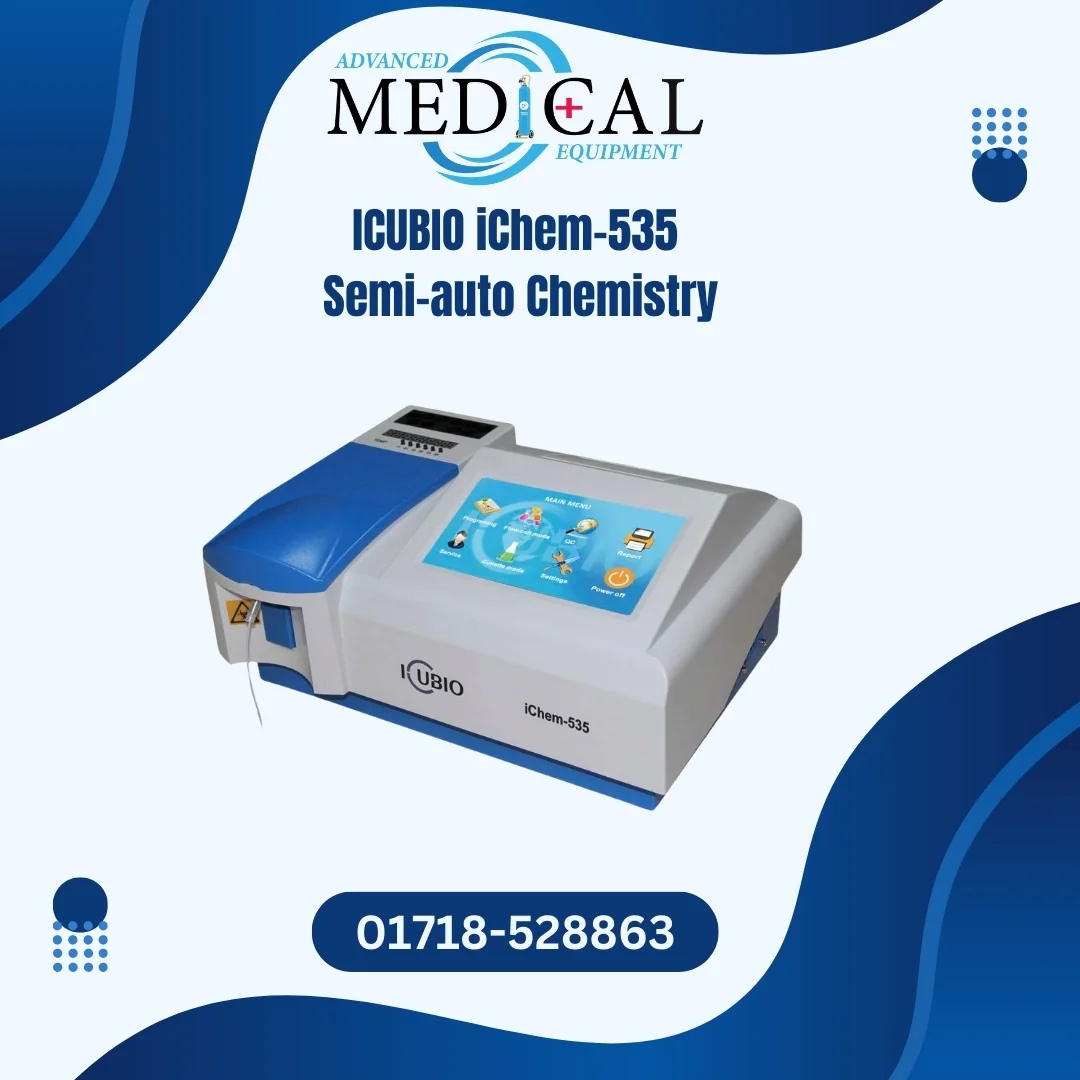
The ICUBIO iChem-535 is a compact semi-automatic biochemistry analyzer built for small and medium laboratories that need dependable clinical chemistry results without the cost of a fully automated system. Made by Shenzhen iCubio Biomedical Technology Co., Ltd., a Chinese manufacturer of in-vitro diagnostic instruments and reagents, the iChem-535 combines a seven-inch colour touchscreen, seven optical filters, a flow-cell and cuvette operating mode, and storage for ten thousand sample results. Advanced Medical Equipment supplies the iChem-535 to diagnostic centres, hospital laboratories, clinics and teaching institutions throughout Bangladesh.
What Is a Semi-Auto Chemistry Analyzer?
A chemistry analyzer measures the concentration of substances in blood serum, plasma or other samples by passing light through a reacted sample and reading how much light is absorbed. In a semi-automatic model, the operator prepares the sample and reagent and presents the sample to the instrument, while the analyzer handles the measurement, calculation and reporting. This approach keeps the instrument affordable and flexible, and it suits laboratories with moderate daily sample numbers or those that want an independent backup for a larger analyzer. Typical tests include liver function, kidney function, blood glucose, lipid profile, cardiac enzymes and electrolytes by photometric methods, depending on the reagents you use.
Key Features of the iChem-535
- 7-inch colour LCD touchscreen: The main menu is clear and icon-based, covering programming, flow-cell mode, cuvette mode, QC, service, settings, report and power off.
- Real-time reaction curve: The analyzer shows the reaction curve while the test runs, helping the operator judge linearity and spot problems.
- Seven standard filters plus one free position: The wavelengths are 340, 405, 492, 510, 546, 578 and 630 nm, covering the common clinical chemistry methods.
- 80 test items pre-programmed: Common assays are already set up, and users can add their own parameters.
- Memory for 10,000 results: Patient and QC data are stored for review and reporting.
- Flow-cell and cuvette modes: Choose aspiration through the flow cell for fast routine work or use a cuvette for special methods and small volumes.
- Lamp hibernate function: The light source can sleep when idle, which helps extend lamp life.
- Optional incubator: A ten-position incubator is available as an option, holding temperatures such as 37 degrees Celsius.
- Built-in thermal printer and RS-232 interface: Print reports directly or connect to a computer.
- Quality control: Levey-Jennings quality control curves with mean, SD and CV percentage are provided for each test item.
Technical Specifications (Manufacturer Data)
The following details are taken from the manufacturer's published information. Always check the datasheet supplied with your unit, as specifications may be updated without notice.
- Test modes: kinetic, end point, two-point and absorbance.
- Wavelength precision: plus or minus 2 nm, bandwidth 10 nm or less.
- Absorbance range: 0 to 4.500 Abs.
- Flow cell: 32 microlitre quartz glass cell, 10 mm path length.
- Sample volume: 0 to 3,000 microlitres, with 500 microlitres recommended.
- Light source: Philips 6 V, 10 W halogen lamp.
- CPU: ARM series high-speed microprocessor.
- Power supply: 100 to 240 VAC, 50 to 60 Hz, 100 VA.
- Dimensions: 340 mm long, 270 mm wide, 160 mm high.
- Weight: 5 kg net, 10.5 kg gross.
- Working environment: 0 to 40 degrees Celsius, humidity up to 80 percent.
Applications in the Laboratory
Liver function tests. Measure enzymes such as ALT and AST, along with bilirubin and total protein, using compatible reagents.
Kidney function tests. Run urea, creatinine and uric acid to monitor renal health.
Blood glucose and lipids. Perform glucose, cholesterol, triglycerides and HDL for diabetes and cardiovascular screening.
Cardiac and other enzymes. Photometric assays for enzymes such as CK, CK-MB and LDH, where reagents are available.
Teaching and research. The open parameter system and easy interface make the analyzer suitable for training laboratory technologists.
Because this is an open system, laboratories can choose reagents from different suppliers as long as the method and wavelength are compatible and the parameters are programmed and validated. Validate every new assay with controls and calibrators before reporting patient results.
Why Laboratories Choose the iChem-535
Affordable entry to automation. A semi-automatic analyzer costs far less than a fully automatic chemistry system and still delivers photometric accuracy, quality control tools and electronic records.
Easy to learn. The touchscreen interface and clear menu reduce training time for new staff.
Flexible method support. Seven filters, four test modes and an open parameter set allow a wide choice of assays.
Compact footprint. At roughly the size of a small bench printer, it fits a crowded laboratory table and is light enough to move if the layout changes.
Backup role. Hospitals with a large analyzer often keep a semi-automatic unit for urgent tests, special assays or breakdown cover.
Setting Up and Operating the Analyzer
Place the analyzer on a stable, level bench away from direct sunlight, vibration, drafts and strong electrical interference. Connect it to a stable power supply, ideally through a voltage stabilizer or online UPS, because lamp life and measurement stability both benefit from clean power. Allow the instrument to warm up as instructed so the lamp reaches steady output. Select the test in the menu, run a reagent blank, and calibrate with a suitable calibrator if the method requires it. Load the sample through the flow cell or cuvette, read the result on screen and print it if needed. Run quality control materials at the start of each shift and whenever you change reagent lots.
Maintenance Tips
- Flush the flow cell and tubing with distilled water after each working session to prevent protein and reagent build-up.
- Follow the manufacturer's instructions for cleaning the flow cell with a suitable cleaning solution at the recommended intervals.
- Let the lamp hibernate function work, and replace the halogen lamp when intensity drops or when the analyzer warns you.
- Keep the optical windows free of dust and fingerprints.
- Wipe the casing with a soft damp cloth; never spray liquid into the instrument.
- Schedule periodic checks of wavelength accuracy, absorbance linearity and temperature if you use the incubator.
Biosafety
All blood and serum samples should be treated as potentially infectious. Operators should wear gloves, a laboratory coat and eye protection, and follow their laboratory's biosafety protocol. Dispose of waste liquid and contaminated consumables according to local regulations for biomedical waste.
Frequently Asked Questions
Is the iChem-535 a closed or open system? It is an open system, so you can program parameters for compatible reagents.
Does it include an incubator? The ten-position incubator is listed as optional. Ask us when ordering.
Can it connect to a computer? Yes, it has an RS-232 interface for PC connection.
What power supply does it need? The manufacturer lists 100 to 240 VAC at 50 to 60 Hz, which covers the Bangladesh mains supply.
Do you supply reagents and training? We can help you source compatible biochemistry reagents, controls and calibrators, and arrange installation guidance. Please ask for details.
Is warranty available? Warranty terms depend on the supply. Confirm the warranty period and service support before purchase.
Order from Advanced Medical Equipment
Advanced Medical Equipment supplies laboratory instruments, reagents and clinical equipment to diagnostic centres and hospitals across Bangladesh. To request a quotation, confirm stock, discuss reagents or arrange delivery and installation guidance, call 01718-528863. Our team will help you choose the right analyzer configuration for your daily test volume and budget.