Description
Health Care Multi-Parameter Patient Monitor (12 Inch Colour Display) for Bedside Monitoring
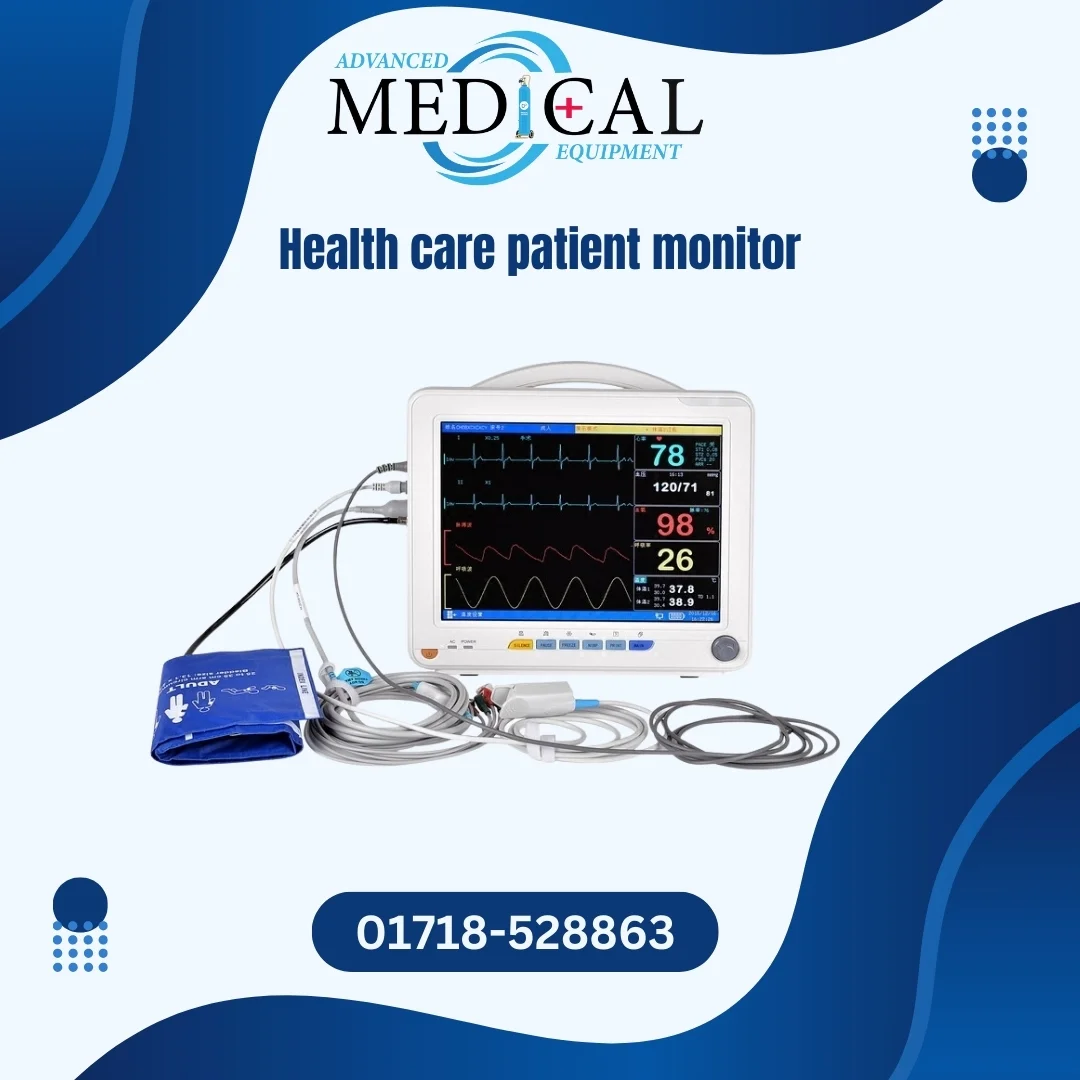
In hospital wards, intensive care units, emergency rooms, operation theatres and recovery areas, staff need to know at a glance how a patient's heart, breathing and circulation are doing. A multi-parameter patient monitor brings the most important vital signs together on one screen and sounds an alarm when a value moves outside the limits set by the clinician. The Health Care Patient Monitor offered by Advanced Medical Equipment is a bedside unit with a large colour screen, a top carry handle, a front panel of function keys and a rotary knob, and a full set of cables and sensors, as shown in the product photo.
The screen in the photo shows a heart rate of 78, a blood pressure reading of 120/71, an oxygen saturation of 98 per cent, a respiration rate of 26 and two temperature channels, together with ECG, plethysmograph and respiration waveforms. These values are an example of the display and not a patient record. To confirm the exact configuration, accessories and options, call 01718-528863.
Parameters Monitored
Standard multi-parameter monitors in this category measure six basic vital signs, which together give a broad picture of a patient's condition. Electrocardiogram (ECG) monitoring tracks the electrical activity of the heart and displays the heart rate and rhythm. Non-invasive blood pressure (NIBP) uses an inflatable cuff to measure systolic, diastolic and mean pressure at set intervals or on demand. Pulse oximetry (SpO2) uses a finger probe to estimate the percentage of haemoglobin carrying oxygen and shows the pulse rate and a plethysmograph waveform. Respiration rate (RESP) is derived from chest impedance through the ECG leads. Temperature (TEMP) is measured with skin or body probes and, in the monitor shown, two channels are displayed.
- ECG with multi-lead display of waveforms and heart rate
- NIBP with adult cuff, as shown in the photo, and options for other cuff sizes
- SpO2 and pulse rate with sensor and waveform
- Respiration rate and waveform
- Two temperature channels on the screen shown
- Alarms with adjustable limits and audible and visual indicators
Display and Controls
The monitor has a large, high-resolution colour TFT display, commonly 12.1 inches with 800 by 600 pixels in this class, that shows several waveforms and numeric values with colour coding for each parameter. Coloured text for heart rate, blood pressure, oxygen saturation, respiration and temperature makes it easier for staff to scan the screen quickly. Below the display, a row of function keys and a rotary knob provide access to alarm silence, freeze, NIBP start, menu and other functions. Indicator lights show whether the monitor is on mains power or battery. The handle on the top lets staff transport the unit from bed to bed or to another room.
Alarm and Safety Functions
A monitor is useful only if it alerts staff when something changes. This unit class supports adjustable upper and lower alarm limits for each parameter, so that clinicians can tailor alerts to adult, paediatric or neonatal patients. When a value moves outside its limit, the monitor sounds an audible alarm and flashes a visual indicator. Staff can silence an alarm temporarily while they respond but should never disable alarms permanently. Many models also include trend tables and graphs that show how parameters have changed over hours, which helps clinicians identify gradual deterioration or recovery.
Typical Applications
Patient monitors are used in hospital wards for high-risk patients, in ICUs and CCUs, in emergency rooms for triage and resuscitation, in operating theatres and post-anaesthesia recovery rooms, in dialysis units, in labour rooms, in neonatal and paediatric units, in ambulances and transport and in private clinics that care for patients needing observation. They are also used in sedation procedures, endoscopy suites and day-care surgery centres, where staff must continuously monitor patient safety.
Benefits for Healthcare Facilities
Continuous monitoring allows a small number of staff to keep a close watch over several patients. Early warning of falling oxygen levels, abnormal heart rhythm or unstable blood pressure gives clinicians time to intervene. Having multiple parameters on one screen reduces the need for separate devices and reduces clutter around the bed. A built-in rechargeable battery, which in this class commonly provides several hours of operation, lets the monitor stay on during transport or power cuts, which are still a concern in many parts of Bangladesh. The unit's mains compatibility with 100 to 240 V at 50 or 60 Hz allows reliable operation on the local supply.
Technical Characteristics of This Class
Twelve-inch multi-parameter monitors in the Bangladesh market typically have a standard configuration of ECG, RESP, NIBP, SpO2, TEMP and pulse rate, suit adult, paediatric and neonatal patients, operate from AC 100 to 240 V at 50 or 60 Hz with input power of around 70 VA, and include a rechargeable lithium-ion battery with an operating time of about 2 to 3.5 hours. Optional features on some models include extra temperature or invasive pressure channels, end-tidal carbon dioxide, a thermal recorder, a touch screen and a wall mount. The accessories shown in the photo include an ECG lead set, a blue adult NIBP cuff with tubing, a SpO2 finger sensor and temperature probes. Please confirm the exact model, parameters and optional modules with us before ordering.
Setting Up the Monitor
Place the monitor on a stable shelf, trolley or wall mount where the screen can be seen clearly from the bedside and from the nurses' station. Connect the power cord to an earthed socket and check that the battery indicator is lit. Attach the ECG cable, SpO2 sensor, NIBP cuff and temperature probe to their sockets on the side or back of the monitor. Apply electrodes to clean, dry skin in the correct positions and connect the lead wires. Place the SpO2 sensor on a clean finger, the cuff on the upper arm at heart level and the temperature probe as directed. Select the patient category (adult, paediatric or neonate), set alarm limits according to the clinical situation and confirm that waveforms look clean before leaving the patient.
Cleaning and Maintenance
Switch off and unplug the monitor before cleaning. Wipe the casing and screen with a soft cloth dampened with a mild disinfectant solution compatible with the plastic, and avoid spraying liquid directly on the unit. Clean cuffs, SpO2 sensors and cables according to the manufacturer's recommendations. Inspect cables and connectors for wear and replace damaged accessories promptly. Have the monitor checked by a biomedical engineer for performance and electrical safety on a regular schedule, and replace the battery when run time drops significantly.
Safety Notes
Patient monitors support clinical judgement but do not replace it. Readings may be affected by movement, poor electrode contact, cold fingers, nail polish, ambient light or cuff size. If a reading does not match the patient's appearance, check the patient first and then check the equipment. Use only approved accessories and keep the monitor away from sources of strong electromagnetic interference whenever possible.
Price and Buying Advice for Bangladesh
Twelve-inch multi-parameter monitors are widely available in Bangladesh. Local listings for common models from brands such as Yonker, Hwatime and Lemedical typically range from about BDT 35,000 to BDT 55,000, while monitors with extended modules, touch screens or brands such as Edan can cost BDT 130,000 or more. When comparing, ask about the screen size and resolution, the standard parameters, the type of SpO2 sensor, the available cuff sizes for adults, children and neonates, the battery capacity, the alarm functions, data storage, the warranty period and the availability of accessories such as cuffs, SpO2 probes and ECG leads. Buy from a supplier that can provide service and spare parts.
Why Buy from Advanced Medical Equipment?
We support hospitals, clinics and ICUs with practical monitoring equipment and clear product information. Our team can help you choose accessories, discuss installation and arrange delivery in Dhaka and across Bangladesh. Call 01718-528863.
Frequently Asked Questions
Can the monitor be used for children? Many models support adult, paediatric and neonatal modes, but you need the correct cuff and sensor for each patient group.
How long does the battery last? Monitors of this class commonly have a lithium battery that runs for about 2 to 3.5 hours when fully charged.
Can it print or connect to a central station? Some models offer a recorder or network options. Confirm what is available for your configuration.
Which accessories are included? The photo shows an ECG cable, an adult NIBP cuff, a SpO2 sensor and temperature probes. Please confirm the packing list at the time of order.